Blog
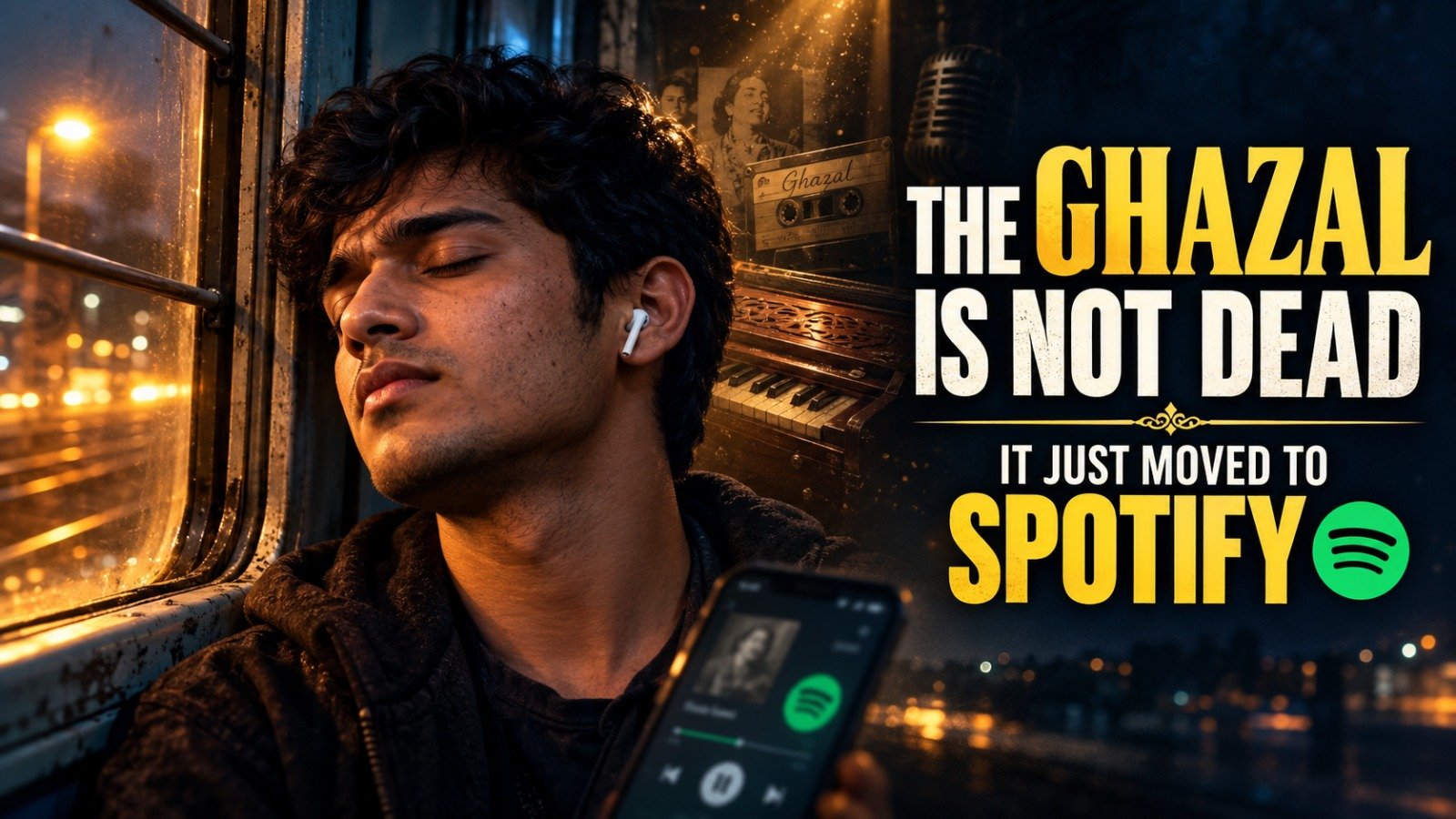
The Ghazal Is Not Dead, It Just Moved to Spotify
Ask anyone under twenty-five what a ghazal is, and you might expect a blank stare. Instead, increasingly, you get a playlist link.
Somewhere between late-night hostel conversations and early-morning commutes, a genre that many assumed belonged strictly to their grandparents has quietly slipped back into circulation. Not through All India Radio. Not through cassette players. Through Spotify, YouTube, and Instagram reels that clip a single sher and let it do the rest.
From Cassette to Queue
There is a particular kind of listener driving this shift, and their story usually starts the same way: a stray recommendation, a friend's playlist, or a song their parents played in the car years ago that suddenly makes sense now. One young listener, quoted in a recent piece on the trend, described discovering ghazals through college friends who played them during Spotify jam sessions — sessions where the songs felt out of place at first, until they didn't. "You listen to it a couple of times and you're like, you know what, there is a place for this," he said, describing how ghazals eventually became his preferred late-night or early-morning listening, precisely because of how unhurried they are. Unlike a three-minute pop single built for a chorus hook, a ghazal takes its time, letting a single line of poetry sit and breathe before moving on.
That patience is exactly what seems to be pulling younger audiences in. In an era where most music is engineered to grab attention in the first seven seconds, a genre that refuses to rush feels almost rebellious.
The Industry Isn't Surprised
People who have spent decades around folk and ghazal traditions see this less as a trend and more as a correction. Ashutosh Sharma, founder of Amarrass Records, has described the renewed interest among younger audiences as less of a surprise and more of a return to the natural order of things — the idea being that this music never really went anywhere, it simply waited for the right doorway to reopen. That doorway turned out to be a streaming app.
The numbers back this up in their own quiet way. Jagjit Singh, arguably the most recognisable name in modern ghazal, currently pulls in around five million monthly listeners on Spotify — a staggering figure for an artist who passed away in 2011 and never released a single song built for algorithmic discovery. Spotify's own editorial playlist "Golden Ghazals" has amassed well over 140,000 saves, curated and reshared by listeners who weren't even born when most of these recordings were made.
Why Spotify, Specifically
Spotify entered India in 2019 and, within a handful of years, became the most-used audio streaming platform among Gen Z and millennial listeners in the country. That matters here because streaming platforms don't just host music, they route it. A single late-night ghazal session, saved to a playlist and shared with three friends, does more for genre revival than a decade of nostalgic television specials ever could. Indian music's global reach has also grown sharply in recent years, with international consumption of music from India climbing 85 percent year-on-year by 2023 — proof that the audience for this sound was never as narrow as assumed, just under-served by the old distribution model.
A Quiet, Deliberate Comeback
What is happening with ghazals is not a revival built on spectacle. There are no viral dance trends attached to Mehdi Hassan or Begum Akhtar. Instead, it is built on something slower and arguably more durable: young listeners actively seeking out complexity, patience, and heartbreak that doesn't announce itself with a drop. As one performer working to keep the tradition alive put it, the hope is that these performances plant seeds in the next generation's hearts, seeds that grow into a genuine curiosity about the tradition rather than a passing phase.
Ghazal was never dead. It was simply waiting on the right platform, the right playlist, and a generation patient enough to listen to a song that takes its time getting to the point.